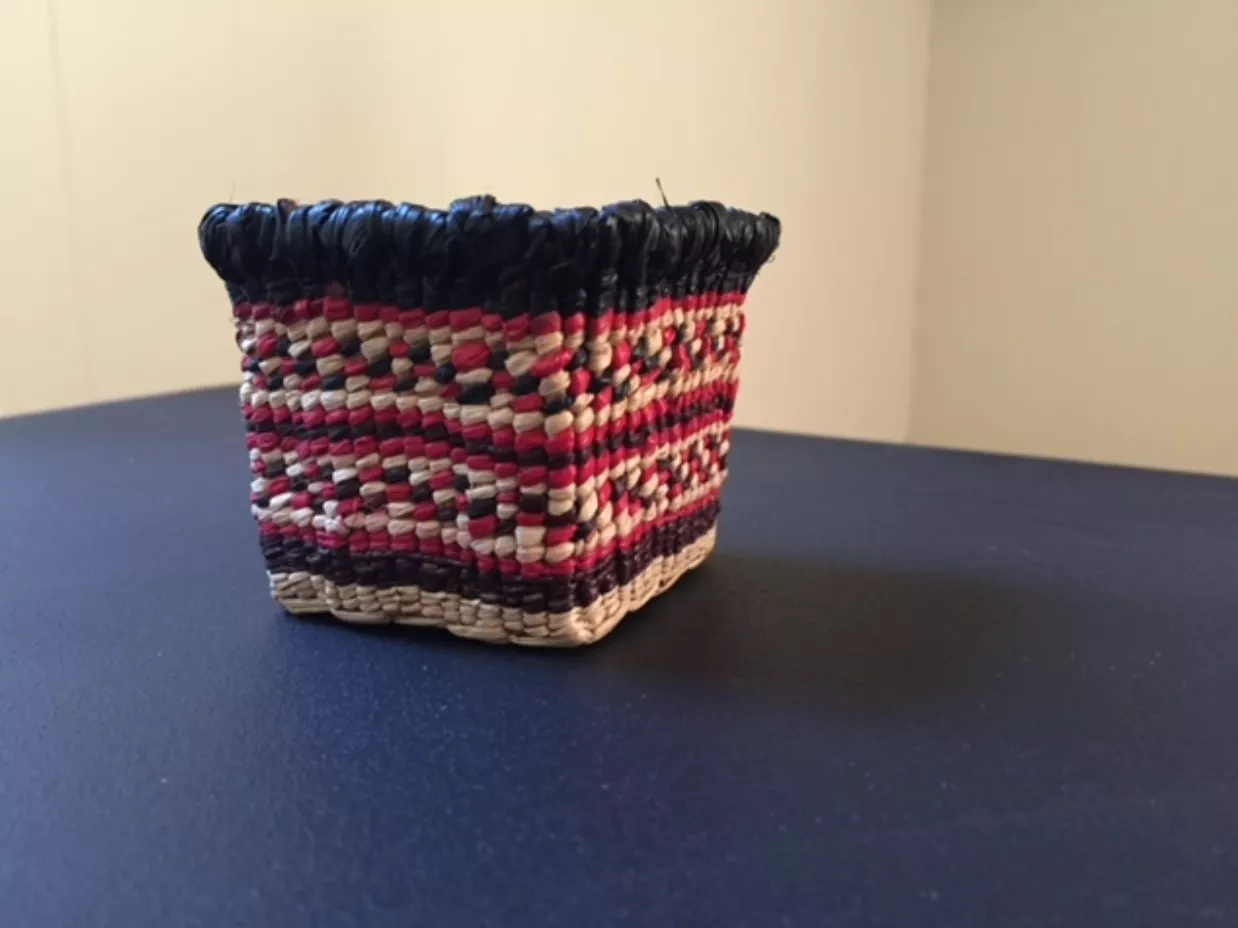
This month as part of the Quw’utsun Elders Backyard Sessions at Lila Music and Nature Centre, we are hosting a cedar basket weaving workshop, offered by Cowichan weaver Sulsameethl (Deb George). Sulsameethl, will be teaching about the cultural significance and traditional methods of Coast Salish cedar weaving. Participants will learn about the historical and contemporary value of the Cedar Tree of Life, through the Salish perspective, and will be learning how to make a small basket.
Sulsameethl, who has lived in the Cowichan Valley her whole life, is of mixed ancestry herself: Cowichan, Scottish and English, and believes this has given her a unique lens with which to see the world. She is also an educator, artist and social justice activist. She considers weaving a family activity, starting with harvesting the cedar together and taking the time to prepare the bark carefully, with the greatest respect towards the cedar tree and the weaving materials it provides. The experience of weaving is more than simply creating a basket, it is also about the transfer of cultural knowledge between generations, and sharing it with audiences eager to learn.
Weaving connects us and teaches us about the land, ancestry and our diverse cultures. Cedar bark traditionally was abundant in the rare biodiversity of the Coast Salish territories, and the tender inner bark is used for weaving baskets and making clothing fibre. Cedar bark is first made pliable by soaking the fibers for up to two days, and then carefully hand-worked, by bending and twisting the fibers apart, one strand at a time. After this lengthy preparation, the strips are ready to be utilized.
It is even more important now to protect Western Red Cedar, known as Xpey’ in the traditional Hul’qumi’num language of the Quwut’sun Coast Salish Peoples, as these trees have been impacted significantly by environmental issues and land development. Xpey’ is said to be the sunt’le’ of the trees. The sunt’le’ refers to the eldest sibling in Hul’q’umi’num’, and exists among many species. For example, the sunt’le’ of the fish is the Chum, and the suntle’ of the antlered mammals is the elk. In Quw’utsun, they hold this esteem for Xpey’, because of their immense respect for the ongoing relationship they have had and maintain with Xpey’ today. They owe their lives to Xpey’, for all the ways it has given itself to the Coast Salish people. From birth to death, they have used it as clothing, longhouses, canoes, ceremonial masks, and even for coffins, where their bodies are laid to rest.
Xpey’ does not live at nearly the same abundance and scale it once used to. Old growth forests in Quw’utsun territory are rare, with no more than 1% remaining. This has been primarily due to historical logging impacts, current harvesting practices, as well as contemporary land development. Another factor affecting the health of Xpey’ is a warming climate. Elders have commented on the way this eldest tree species has been treated, likening it to the way our hwulmuhw elders have been treated.
Efforts are being made to restore and protect through education, arts, digital storytelling and stewardship, including the local organization, Social Planning Cowichan and through educational workshops offered through the Elders Backyard Sessions. The late visionary elder who continues to influence the Xpey project, established a vision to ‘stand up for Xpey’ ‘ for future generations. From this vision, the Xpey’ project was created to protect the remaining old growth and mature cedar trees, while restoring areas where cedar would grow well and thrive. His wishes were to plant one tree for every child who did not come home from residential schools, as a memorial for those who were lost, and as a gift to future generations.